

In this article, we will discuss what is Microsoft Dynamics 365, the shift toward autonomous AI agents in 2026, and how its modular CRM and ERP pillars empower business scalability.
The landscape of enterprise software has reached a critical inflection point. For decades, business platforms served primarily as “Systems of Record”—digital databases designed to store and organize information. In 2026, that era has officially evolved.
With the rollout of the 2026 Wave 1 release, Microsoft Dynamics 365 has fully transitioned into a “System of Action.” The conversation has shifted from simply “chatting with AI” to deploying Autonomous AI Agents that execute complex workflows without constant human oversight.
For modern decision-makers, understanding this agentic shift is the new standard for achieving operational scalability and maintaining a competitive edge in an AI-first economy.
What is Microsoft Dynamics 365?
At its core, Microsoft Dynamics 365 is a unified, cloud-based ecosystem of intelligent business applications.
Unlike traditional software that siloes data between departments, Dynamics 365 breaks down these barriers by hosting all your applications on a single platform—the Microsoft Dataverse.
This shared data model ensures that information updated in your sales department is instantly reflected in your finance and supply chain modules. The platform is inherently modular, meaning you only pay for the specific applications you need, whether that is a full-scale ERP or a targeted CRM solution.
In 2026, its defining characteristic is the deep integration of Microsoft Copilot, which transforms the platform from a tool you “use” into a digital partner that “acts” on your behalf.
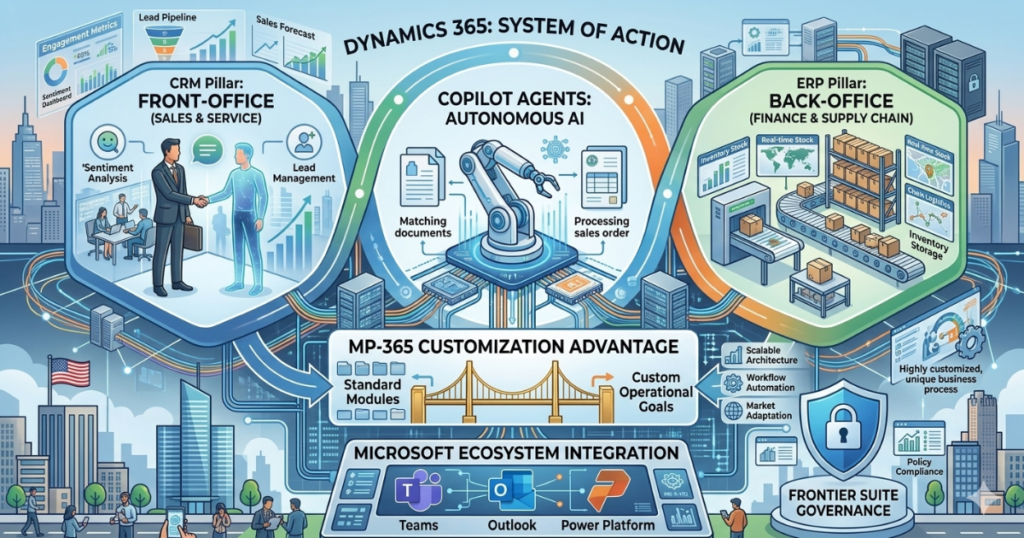
The Two Operational Pillars: CRM vs. ERP
Dynamics 365 unifies your business into two main functional areas, ensuring that every touchpoint—from the first marketing email to the final invoice—is tracked and optimized.
Microsoft Dynamics 365 CRM (The Front-Office)
Focusing on Sales, Marketing, and Customer Service, the Microsoft Dynamics 365 CRM modules are designed to drive revenue and long-term retention.
- AI-Driven Lead Management: Modern Copilot agents now perform real-time sentiment analysis on incoming inquiries. By analyzing the tone and intent of emails or chat logs, they autonomously disqualify low-intent leads, allowing your sales team to prioritize high-value opportunities that are ready to close.
- Proactive Service & Field Intelligence: Customer service modules now use predictive modeling to identify potential equipment failures or service lapses. If a connected device signals an error, the system can automatically trigger a service ticket or dispatch a field technician before the client even realizes there is a problem.
Microsoft Dynamics 365 ERP (The Back-Office)
Microsoft Dynamics 365 ERP manages the “engine room” of your business: Finance, Supply Chain, and Operations.
- Dynamics 365 Business Central: This has emerged as the premier “all-in-one” solution for small-to-midmarket businesses. It streamlines core accounting, inventory management, and project operations into a single, easy-to-navigate interface that grows with your company.
- Intelligent Supply Chain: 2026 updates have introduced autonomous rerouting logic. If a global logistics disruption is detected (such as weather or port delays), the system evaluates alternative suppliers and shipping routes, presenting your team with the most cost-effective solution in real-time.
Ready to see where your organization stands? Contact Modern Partners 365 today to book a Copilot Readiness Audit or a comprehensive Dynamics 365 consultation. Let’s turn your system of record into your most productive asset..
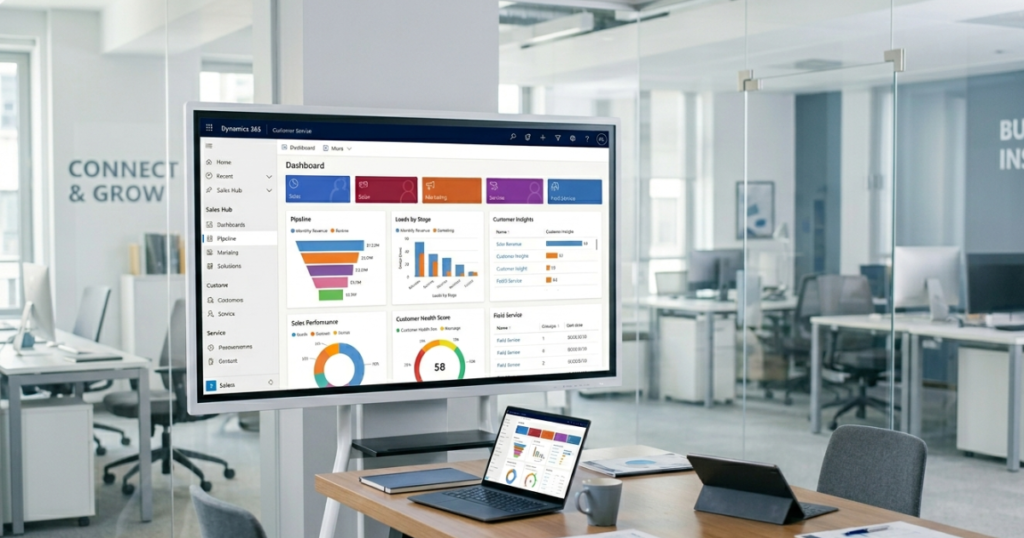
Deep Dive: The Rise of Copilot Agents
The most significant advancement in Dynamics 365 Copilot this year is the evolution of “Copilot agents” These are no longer just assistive tools; they function as digital employees capable of handling end-to-end tasks autonomously within the guardrails you set.
Key 2026 Use Cases:
- The Payables Agent: This agent eliminates manual entry by monitoring finance inboxes, extracting data from invoices with 99% accuracy, and matching them to Purchase Orders (POs). If it identifies a discrepancy, it drafts a clarification email to the vendor and flags the record for human review, significantly speeding up the monthly close.
- The Sales Order Agent: This agent interprets natural-language requests—such as an informal email requesting a restock of a previous order—checks inventory levels across multiple warehouses, creates the sales order, and schedules the shipment in seconds.
- The Strategic Advantage: By deploying Copilot agents, firms can handle significantly higher transaction volumes without a linear increase in administrative costs. It solves the efficiency gap by augmenting human capacity through high-fidelity automation, allowing your staff to focus on strategy rather than data entry.
Integration: The Microsoft 365 Ecosystem & Frontier Suite
One of the primary reasons enterprises choose Microsoft over fragmented competitors is the Power Platform integration. Dynamics 365 is deeply embedded within the tools your team already uses every day:
- Teams & Outlook: Copilot agents can pull data from a meeting transcript to update a CRM record or draft a professional ERP quote directly inside an email client, ensuring your data is always current.
- The Frontier Suite: New for 2026, this unified governance layer allows management to oversee all AI agents from a single dashboard. This provides total visibility into agent performance while ensuring that security, data privacy, and ethical AI boundaries are maintained across the entire organization.
Conclusion: The Roadmap to 2027
The modularity of Microsoft Dynamics 365 is its greatest strength. Organizations do not need to overhaul their entire infrastructure overnight.
The most successful businesses start with specific pain points—such as automating accounts payable or streamlining lead qualification—and add autonomous agents as their confidence and needs grow.
As we look toward 2027, the divide between companies using “static” software and those using “agentic” platforms will continue to widen.