

Quick answer: Dynamics 365 Sales Premium costs $150 per user per month, paid yearly. It adds uncapped AI selling features and 1,000 Copilot Credits per user each month on top of Sales Enterprise. The real question is whether your team will outgrow Enterprise’s monthly limits.
Last updated: October 4, 2026
Most teams treat Dynamics 365 Sales Premium as a feature upgrade. It is closer to a capacity upgrade. Microsoft already lets Sales Enterprise users run several Premium capabilities every month, so the decision turns on volume, not on whether the features exist.
This guide shows what the extra $45 per user buys, where Enterprise stops, and who should pay for Dynamics 365 Sales Premium.
What Is Dynamics 365 Sales Premium?
Dynamics 365 Sales Premium is Sales Enterprise plus AI-driven selling features, sold as one per-user subscription. Those features continuously analyze the customer interaction data stored in Dynamics 365 Sales and collected from Microsoft 365.
The tier began as a bundle. It started as a discount for Sales Enterprise customers adding the Sales Insights add-on, and Microsoft has since added AI capabilities that only Premium or that add-on include.
That history explains why the tiers overlap. Sales Professional covers core sales force automation, Sales Enterprise adds advanced customization and process automation, and Premium layers the AI features on top. Each step up includes everything below it.
Which Premium Features Does Sales Enterprise Already Include?
Sales Enterprise includes four Premium capabilities, and two of them carry monthly limits. Here is how the monthly capacity limits compare.
| Capability | Sales Enterprise | Sales Premium |
| Sales accelerator | 1,500 sequence-connected records per month | No limit |
| Predictive lead and opportunity scoring | 1,500 records per month | No limit |
| Conversation intelligence | No limit | No limit |
| Relationship intelligence | Basic insights from Dynamics 365 data | Advanced insights from Dynamics 365 and Exchange data |
Where the 1,500-Record Ceiling Matters
A monthly cap of 1,500 records matters most when lead volume is high. A busy web form or a large sequence program can reach that figure quickly.
The cap is stated as a monthly number, so confirm how it is measured in your tenant before you plan around it. A team that qualifies a few hundred leads a month may never notice it.
The surprise in the table is conversation intelligence. Enterprise users get it with no monthly cap, so a team buying Premium mainly for call analysis is paying for something it already has.
What the Dynamics 365 Sales Premium Features Add Beyond Enterprise
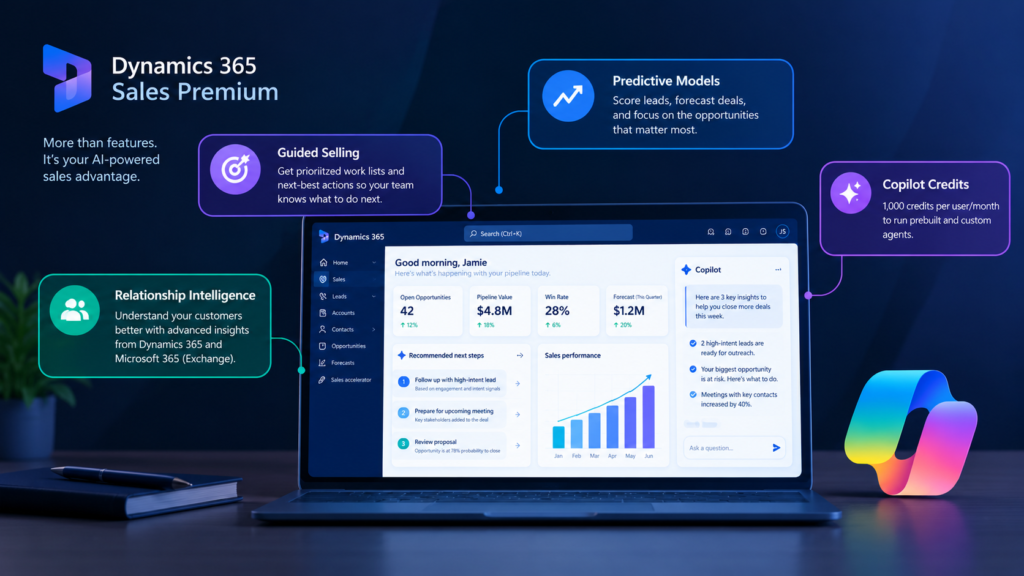
The Dynamics 365 Sales Premium features that Enterprise cannot match are uncapped usage, advanced relationship intelligence, and included agent capacity. They fall into three groups: guided selling, relationship intelligence, and predictive models.
Guided Selling and Predictive Models
Guided selling is the sales accelerator’s prioritized work list, which tells each seller what to do next. Predictive models score leads and opportunities, and predictive forecasting sits in this group too.
In practice, a seller opens the work list and sees which leads and opportunities deserve attention first. Managers get a scoring signal that does not depend on each rep’s gut feel.
Advanced Relationship Intelligence
Relationship intelligence is AI that shows how healthy each customer relationship is and who in your company knows whom. The advanced version draws on Dynamics 365 and Exchange data, while the basic Enterprise version uses Dynamics 365 data only.
The extra Exchange signal matters for account-heavy teams. Email and meeting history show which contacts are going quiet before a deal stalls.
Included Copilot Credits
Dynamics 365 Sales Premium Copilot Credits are the monthly units each license includes for running prebuilt and custom agents. The standard allocation is 1,000 credits per user per month, and agents require them to run.
Prebuilt options include the Sales Qualification Agent and the Sales Opportunity Agent. A team planning to run agents at scale should treat Dynamics 365 Sales Premium Copilot Credits as part of the price, not a footnote.
Dynamics 365 Sales Premium Pricing and License Options
Dynamics 365 Sales Premium pricing is $150 per user per month on the current list price, paid yearly. That is $45 more than Sales Enterprise.
| Tier | Price per user per month (paid yearly) | Copilot Credits included |
| Sales Professional | $65 | None |
| Sales Enterprise | $105 | None |
| Sales Premium | $150 | 1,000 per user per month |
The gap adds up across a team. For 25 sellers, the $45 difference is $1,125 per month, or $13,500 per year.
Heads up: Some third-party pages still list $135 for Premium and $95 for Enterprise. Always confirm current list prices before you budget, since regional pricing and discounts vary.
What a Dynamics 365 Sales Premium License Includes
A Dynamics 365 Sales Premium license is a per-user subscription that includes every Sales Enterprise capability, plus the uncapped Premium features and the included credits.
One detail surprises buyers. The Sales Enterprise, Premium, and Relationship Sales licenses include only limited Sales agent capabilities, and the full experience requires purchasing Microsoft 365 Copilot. Budget for that separately.
Not sure which side of the line your team falls on? If you cannot tell whether your lead volume will hit Enterprise’s limits, Contact MP-365 for a free consultation. We review your sales process and data first, then recommend the license that fits.
Who Should Upgrade to Dynamics 365 Sales Premium
Upgrade when your monthly volume or relationship data needs exceed what Enterprise allows. Premium tends to fit teams like these:
- Teams scoring or sequencing more than 1,500 records per month
- Sellers who need relationship insights built on Exchange data
- Organizations planning to run agents with the included credits
- Sales leaders who want uncapped predictive scoring across the full pipeline
Enterprise tends to fit when:
- Lead volume is modest
- Conversation intelligence is the main draw, since Enterprise has no cap on it
- Forecasting and process automation matter more than AI scoring
Consider two hypothetical teams. A 10-person team that qualifies a few hundred leads monthly and wants call analysis is well served by Enterprise. A 60-person team feeding thousands of web leads into automated sequences will likely cross the 1,500-record ceiling and gains real value from uncapped scoring.
Our guide to Dynamics 365 Sales Enterprise covers what the middle tier includes.
Why Premium Underdelivers Without Clean Data
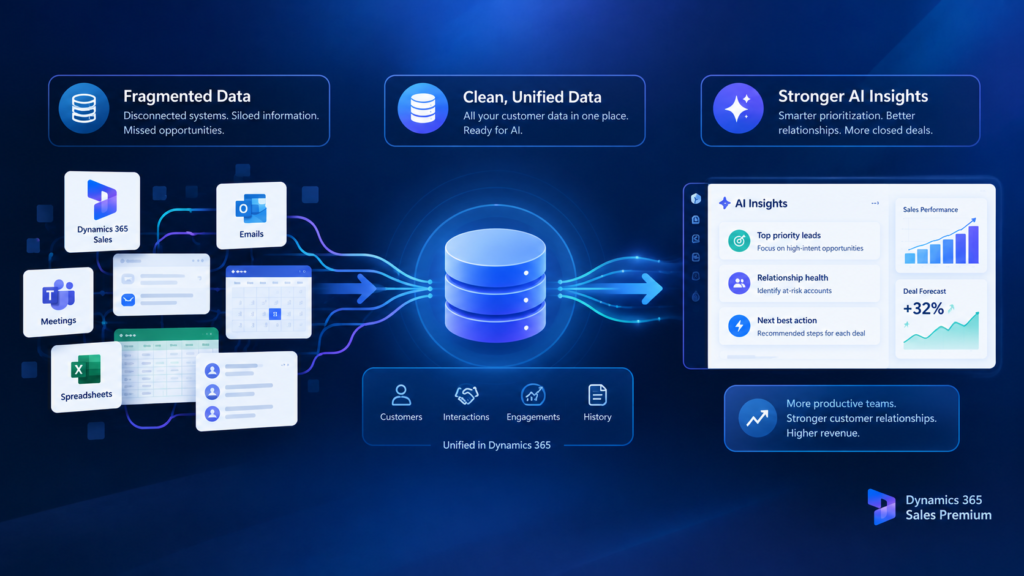
Premium’s AI features are only as reliable as the CRM data behind them. Predictive scoring learns from your lead and opportunity history, so inconsistent stages, missing close reasons, and unlogged activities weaken it.
Our walkthrough of predictive lead scoring configuration covers data readiness before you switch it on. Fix the data first, then pay for capacity.
A quick readiness check before you upgrade:
- Opportunity stages are used consistently across every seller
- Won and lost deals carry a recorded reason
- Emails, calls, and meetings are logged against the right records
- Duplicate accounts and contacts are cleaned up
Key Takeaways
- Dynamics 365 Sales Premium pricing is $150 per user per month, paid yearly, versus $105 for Enterprise.
- Enterprise caps the sales accelerator and predictive scoring at 1,500 records per month. Conversation intelligence has no cap.
- Each Premium license includes 1,000 Copilot Credits per user per month for agents.
- The full Sales agent experience needs Microsoft 365 Copilot on top of any tier.
- Clean CRM data matters more than the license tier.
Conclusion: Is Dynamics 365 Sales Premium Worth It?
Dynamics 365 Sales Premium is worth the extra $45 per user when your volume, relationship data, or agent plans exceed Enterprise limits. For lower-volume teams, Enterprise already delivers several of the same capabilities.
Start with your numbers, not the feature list. Count your monthly lead volume, decide whether agents are on your roadmap, and check the state of your data before you commit to a higher tier.