

What the Client Told Us
“We’re running our entire forecast off a spreadsheet that three different people update. Every Monday we spend the first half hour of the meeting just figuring out whose numbers are actually right.”
That’s roughly how one client described their situation when they first came to MP-365. No mention of software, no technical framing. Just the daily friction of trying to run a sales team on a file that everyone edits separately and nobody fully trusts.
What That Actually Meant
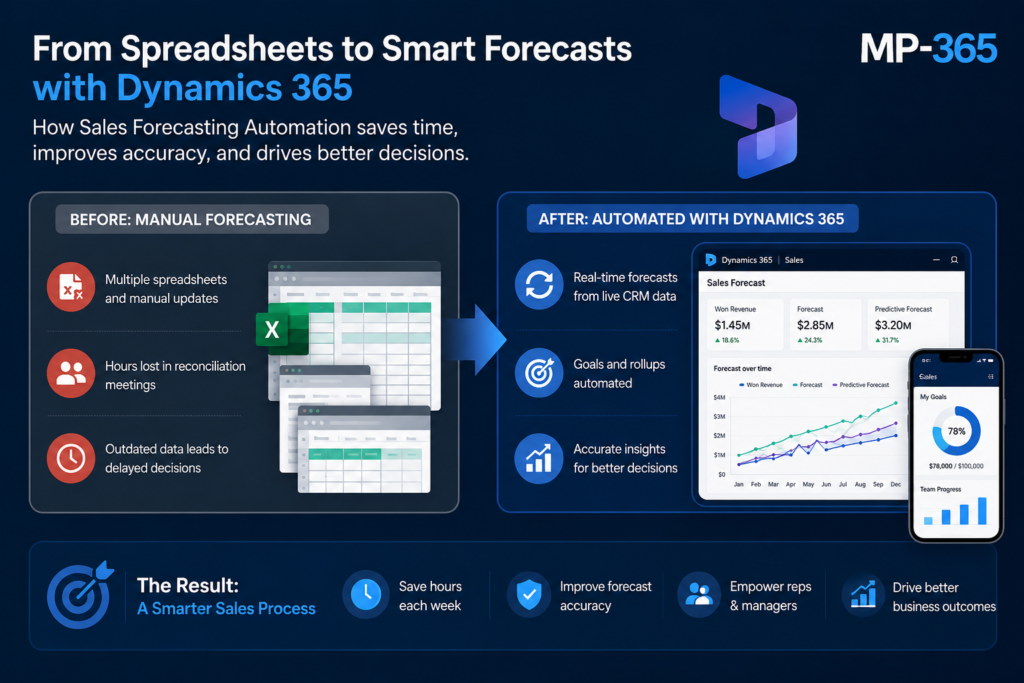
Underneath that description was a familiar technical problem: goal setting and forecasting living entirely outside the CRM, with no Sales Forecasting Automation in place to keep it current. Sales managers maintained individual spreadsheets for each rep, rolled them up manually into a team forecast, and held a recurring meeting whose real purpose was reconciling numbers that didn’t match.
Deals that closed on a Friday afternoon often didn’t make it into the forecast until the following week, so leadership was making pipeline decisions on data that was, at best, several days old. This is one of the most common issues clients bring to us, and it comes with a real cost. A sales team without Sales Forecasting Automation typically loses several hours per week to data entry and reconciliation alone.
Where Sales Forecasting Automation Changes the Equation
Sales Forecasting Automation changes the underlying mechanic, not just the interface. Instead of goals and forecasts living in a separate file that someone updates by hand, they’re built directly on top of the CRM’s live sales data through Dynamics 365 Sales Goal Setting. When a deal moves stage, updates in value, or closes, the forecast reflects it immediately, with no export, no re-entry, and no reconciliation meeting required to catch everyone up.
If manual forecasting is eating into your team’s selling time, it’s worth a conversation about what that process could look like inside your existing CRM data. Contact MP-365 for a free consultation, and we’ll map out exactly where automation replaces manual reconciliation, without disrupting how your reps already sell.
How Goal Setting Works Inside Dynamics 365 Sales
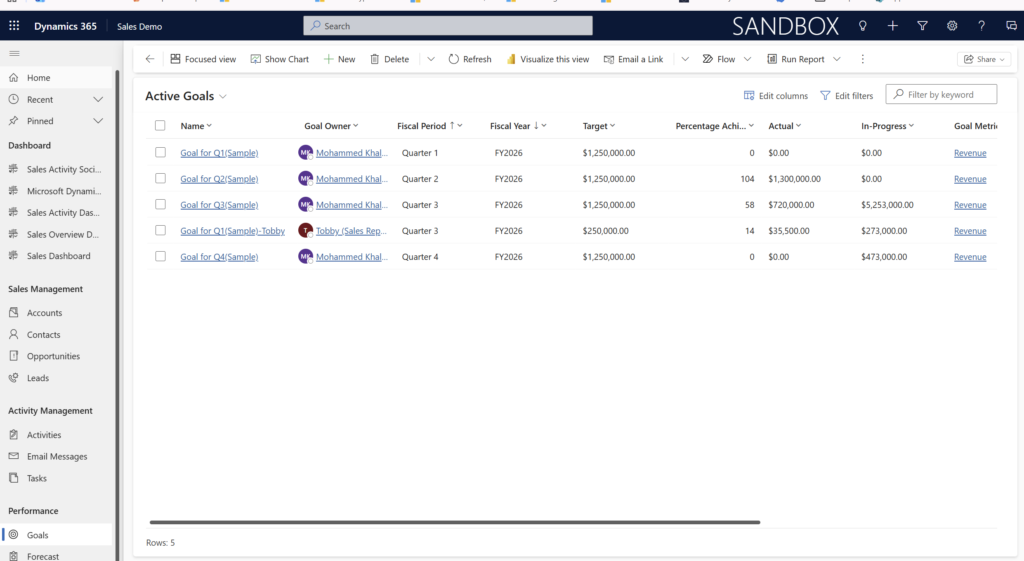
Dynamics 365 Sales Goal Setting works through hierarchical rollups tied to real transactional data. Managers set goals at the team level, and individual rep targets roll up automatically, with no manual aggregation step. Because goals are tied directly to opportunity and revenue data already in the system, actuals update against targets in real time.
Reps work inside the same CRM record they use to manage the deal, so there’s no second system where forecast numbers need separate upkeep, which is the core of what makes Sales Forecasting Automation actually stick day to day.
What Changed for the Client After Implementation
The shift showed up first in meeting cadence. The Monday reconciliation meeting became unnecessary within the first full sales cycle after go-live, because there was nothing left to reconcile once Sales Forecasting Automation was handling the rollups.
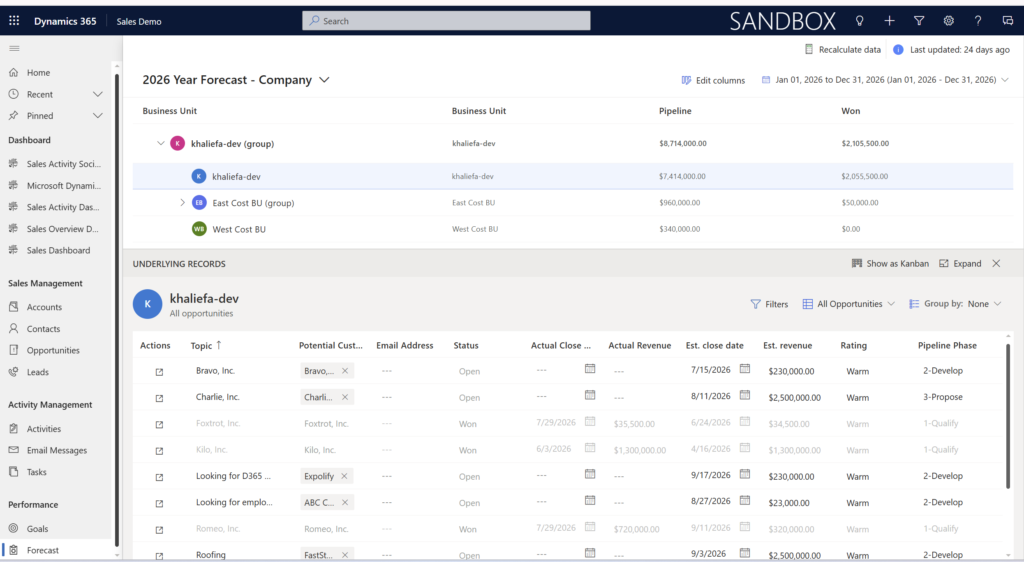
The forecast leadership saw was the same data reps were working from in real time, and forecast accuracy improved measurably simply because the lag between deal activity happening and the forecast reflecting it dropped from days to effectively zero.
Where This Leaves the Sales Team
What this actually frees up isn’t just time. It’s attention. Sales managers who spent part of their week maintaining spreadsheets and chasing updated numbers from reps get that time back for actual pipeline coaching, reps stop being asked to report the same information twice, and leadership stops making decisions on a delayed picture of the business. That’s ultimately what Dynamics 365 Sales Goal Setting is meant to give back: a forecast the team can trust without a weekly meeting to prove it.