

Between 80% and 95% of AI projects fail and most of the advice out there is written for the wrong people. This is the practical framework business owners actually need before starting any AI project.
Most artificial intelligence fails not because of the technology, but because of five missing factors that have nothing to do with AI itself: a clean process, people who understand it, a measurable goal, clean data, and business ownership.
Research from RAND, MIT, and PMI puts the AI failure rate somewhere between 70% and 95%, yet most of the frameworks written to address this problem are aimed at data scientists and IT teams, not the business owners and department heads who are actually making the call to invest.
If you’re running Dynamics 365 and considering a Copilot rollout, or if you’ve already started one and it’s not producing results, the gap is almost never the tool. It’s one or more of these five factors missing before the project even began. This article breaks them down one by one, with real sales scenarios showing exactly what failure looks like and what to do instead.
The Numbers Behind AI failure, What the Research Actually Says
What the Data Shows
The failure rates around AI projects are not exaggerated. RAND’s research report RRA2680-1, based on interviews with over 65 AI practitioners, found that more than 80% of AI projects fail to deliver their intended outcomes.
MIT’s NANDA initiative puts that number even higher 95% of generative AI pilots fail to move beyond the proof of concept stage. PMI’s research lands in the middle, citing a 70–80% failure rate across enterprise AI initiatives.
These are not fringe findings from obscure sources. They are consistent conclusions from some of the most credible research institutions in the world, and they point to a systemic problem that has nothing to do with which AI tool you chose.
Why Generic Advice Doesn’t Land
The problem with most published frameworks on AI failure is that they are written for data scientists, IT leads, and project managers, not for the business owner who just signed a Microsoft 365 Copilot license and wants to know why their sales team isn’t using it.
Technical root causes like model drift, training data bias, and integration complexity are real, but they are someone else’s problem. The business owner’s problem is simpler and more preventable.
There are five factors that separate AI projects that succeed from the ones that don’t and none of them require a technical background to fix.
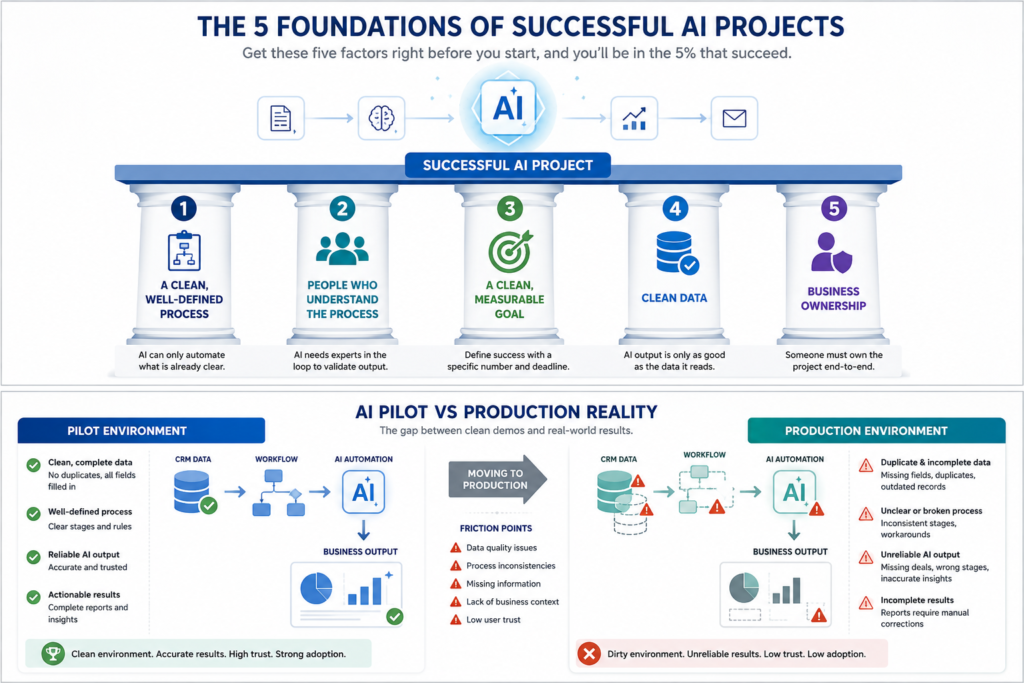
The 5 Factors Your AI Project Needs to Avoid Failure
This is the framework that separates the 5% of AI projects that succeed from the 80–95% that don’t. None of these factors are technical. All of them are within a business owner’s control before a single prompt is written.
Factor 1: A Clean, Well-Defined Process
AI can only automate what is already clear. If the process it is supposed to support is broken, undocumented, or inconsistent, the AI output will reflect that chaos back at you at scale. Before any AI project starts, the process it will touch needs to be mapped, tested, and agreed on by the people who run it every day.
Example:
A sales team asks Copilot to automate lead qualification in Dynamics 365, but no one has defined what a qualified lead actually looks like. Copilot flags every inbound contact as qualified. The pipeline fills with noise and the sales rep stops trusting the output within the first week.
Factor 2: People Who Understand the Process
AI needs a human in the loop who can look at the output and tell you whether it is right or wrong. That person cannot be a junior team member or a data entry administrator. It needs to be someone senior enough to know when the AI is producing something useful and when it needs to be corrected because in the early stages, it will need to be corrected.
Example:
Copilot generates opportunity summaries for the weekly pipeline review. A junior sales coordinator reviews them, spots nothing wrong, and forwards them to leadership. The summaries miss three stalled deals because the coordinator didn’t know what to look for.
Factor 3: A Clean, Measurable Goal
“Use AI more” is not a goal. A goal is something you can measure at the end of 90 days and answer yes or no to. Increase revenue by 15%. Reduce client response time by 30%. Cut deal review prep from 45 minutes to 10. Without a measurable goal, there is no way to know if the project is working and projects without a clear success metric get abandoned the moment they hit the first obstacle.
Example:
The sales director sets a goal to reduce the time spent preparing for client calls from 45 minutes to 10 minutes using Copilot in Dynamics 365. That’s measurable. That’s a project. “Use Copilot more in sales” is not.
Factor 4: Clean Data
AI runs on two things: process and data. If the data it reads is incomplete, duplicated, or outdated, the output will be unreliable and unreliable output destroys adoption faster than anything else. Before any AI project touches your CRM or your ERP, the data inside it needs to be in a state you would trust a human analyst to work with.
Example:
A sales manager asks Copilot to surface the top five at-risk opportunities this week. Dynamics 365 has 200 duplicate contact records and 60% of opportunities have no close date entered. Copilot returns incomplete results and the manager loses confidence in the tool after the first use.
Factor 5: Business Ownership
Someone inside the business needs to own the AI project end-to-end. Not sponsor it. Not approve the budget for it. Own it meaning they understand the goal, they understand the process, they are accountable for the outcome, and they are present enough to course-correct when something goes wrong. Without that person, every AI project eventually becomes a pilot that no one killed and no one scaled.
Example:
The VP of Sales sponsors a Copilot rollout but hands execution entirely to IT. Six weeks later, Copilot is technically live but the sales team hasn’t adopted it, no one defined the use cases, and the VP assumes it failed because “AI doesn’t work for sales.”
Ready to Get Your AI Project Right the First Time?
Modern Partners 365 helps small and medium businesses get the best out of Dynamics 365 and Copilot, from cleaning your data and defining your processes to deploying Copilot Cowork workflows your sales team will actually use.
Book a free AI assessment: Contact Modern Partners 365
What This Looks Like in Practice A Dynamics 365 Scenario
Consider a sales manager at a mid-sized business running Dynamics 365. She wants to use Copilot Cowork to automate the weekly opportunity summary, pulling all open deals, building a PDF with a pipeline funnel, and emailing it to the team.
In the past, this meant three manual steps: go to Dynamics, export the report, convert to PDF, send. With Copilot Cowork, one prompt handles the entire workflow while she moves on to something else.
When All 5 Factors Are in Place
Here is what the setup looks like when it works:
- The opportunity stages in Dynamics 365 are clearly defined qualify, develop, propose, close
- A senior sales manager reviews the output before it goes to leadership
- The goal is specific: cut pipeline reporting time from three hours to twenty minutes per week
- The CRM data is clean, contacts are deduplicated, every opportunity has a close date and a stage
- The sales manager owns the rollout she defined the use case and is accountable for the result
Copilot Cowork pulls the opportunities, builds the PDF, identifies the responsible sales rep for each deal without being told, and sends the report to the right people. The manager comes back to a finished deliverable not a draft.
When One Factor Is Missing
Now remove Factor 4 clean data.
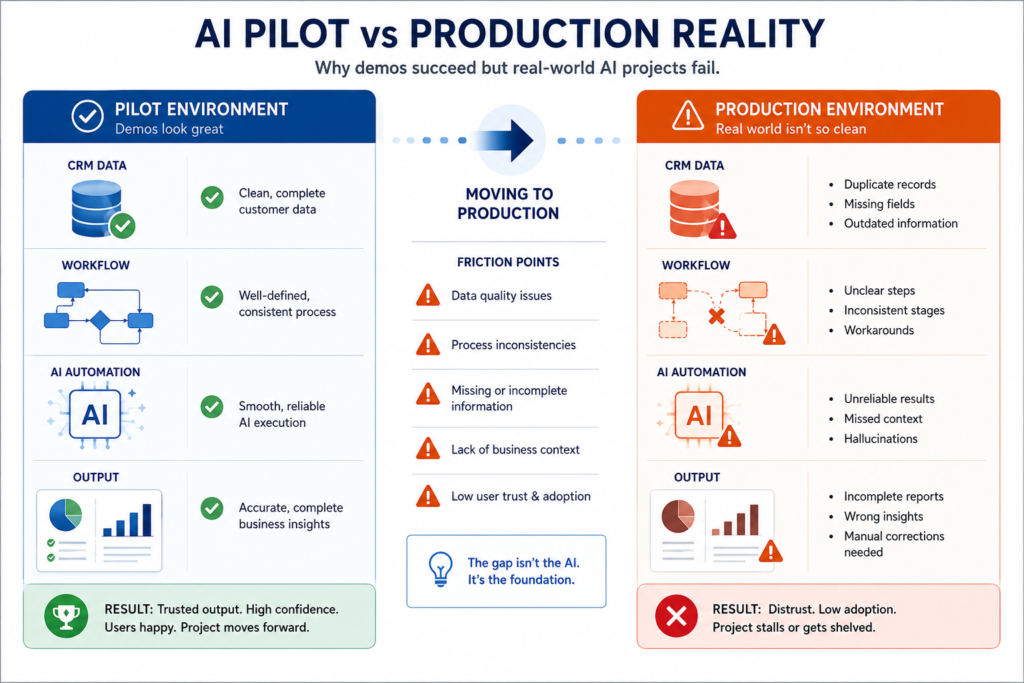
The CRM has duplicate contacts and incomplete opportunity records. Copilot returns a summary that misses four open deals, shows two opportunities in the wrong stage, and generates a funnel that does not match what the team sees when they log in manually.
The manager sends a correction email. The sales rep loses trust in the tool. The project stalls, not because Copilot failed, but because the data it read was never ready for it.
The Pilot-to-Production Gap
This is the most common AI failure mode in practice. The demo works because demo environments have clean data and defined processes. Production fails because real businesses don’t, until someone makes the five factors a prerequisite, not an afterthought.
The One Factor Most Businesses Skip and Why It Kills AI Projects
Of the five factors, business ownership is the one most often missing and the one that makes all the others irrelevant when it is absent. You can have clean data, a defined process, and a measurable goal, and still watch the project collapse if no one inside the business is accountable for driving it forward
What Business Ownership Actually Means
Business ownership is not the same as budget approval or executive sponsorship. It means one person or one department understands the vision, owns the process, defines what success looks like, and is present enough to course-correct when something goes wrong.
That person does not need to be technical. They need to understand the business outcome well enough to know whether the AI is delivering it or not.
The Science Experiment Trap
Without that owner, most AI projects follow the same pattern. A tool gets deployed. A proof of concept looks impressive in a demo. Leadership sees potential. Then nothing happens.
The IBM Institute for Business Value’s 2025 CEO Study found that only 16% of AI initiatives have achieved scale at the enterprise level. The remaining 84% are stuck in exactly this pattern — what IBM calls the science experiment trap. Multiple POCs. Recurring demos. No production. No measurable outcome. Just a growing collection of pilots that no one killed and no one scaled.
What Happens Without It
The trigger phrase for this failure mode is “let’s give it a try.”
When a Copilot rollout starts with that sentence instead of a defined owner, a measurable goal, and a named success metric, the outcome is predictable. The tool goes live. Adoption is low. No one follows up. Six months later the project is quietly shelved and the conclusion is that AI doesn’t work when the real conclusion is that ownership was never assigned.
RAND’s research identified leadership failure as the primary cited cause of AI project failure across more than 65 practitioner interviews. It is not a secondary issue. It is the root cause that makes every other factor harder to fix.
Before Your Next AI Project: A Checklist
Most artificial intelligence fails for reasons that have nothing to do with the technology. The research is consistent, the pattern is predictable, and the fix is available to any business owner willing to do the work before the project starts, not after it stalls.
Before you deploy Copilot, automate a sales workflow, or hand a prompt to Dynamics 365, run through this checklist:
- Do you have a clean, well-defined process that the AI will support?
- Do you have senior people in the loop who can validate the output?
- Do you have a measurable goal with a specific number and a deadline?
- Is your CRM data clean enough that you would trust a human analyst to work with it?
- Does someone inside the business own this project end-to-end, not just sponsor it?
If the answer to any of those is no, that is where the work starts. Not with the tool.
What Success Looks Like
A sales team that has all five factors in place reduced manual pipeline reporting time from three hours to twenty minutes per week using Copilot Cowork with Dynamics 365. Deal review prep dropped from 45 minutes per client to under 10. Those are not exceptional results, they are what happens when the foundation is right.
What to Do Next
Book a free AI readiness assessment with Modern Partners 365 and find out exactly which of the five factors your business is missing before your next project starts: Modern Partners 365
Modern Partners 365 helps small and medium businesses get the best out of Dynamics 365 and Copilot, from the foundation to full deployment. The five factors are not a theory. They are a checklist your next project can actually use.