

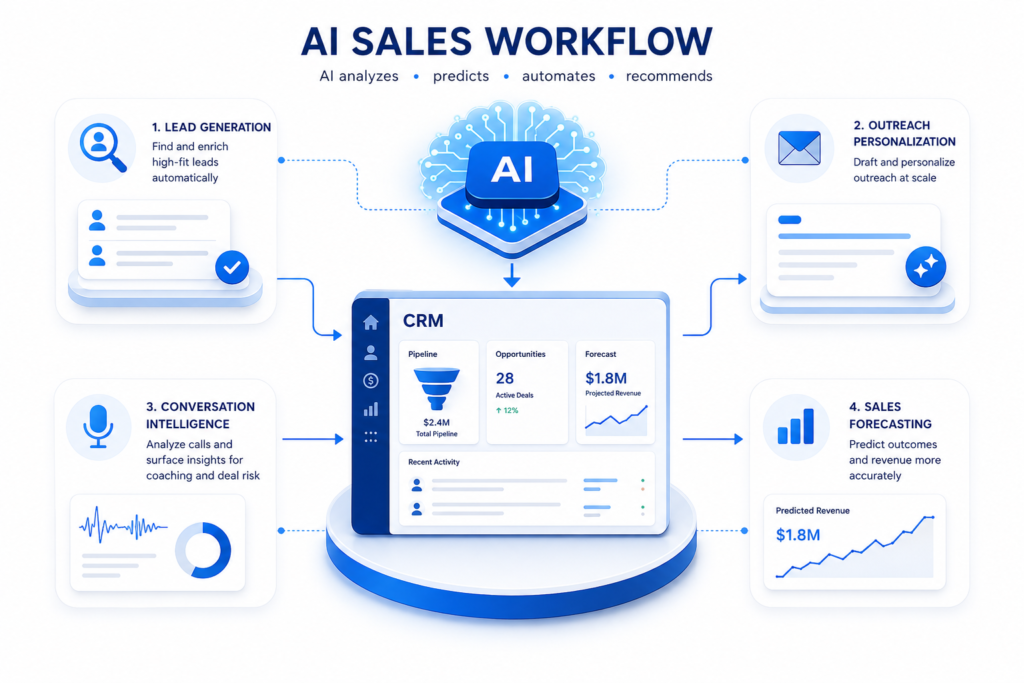
AI sales tools are software platforms that use artificial intelligence including machine learning, natural language processing, and predictive analytics to automate sales tasks, surface insights, and help reps close deals faster. They sit on top of or alongside a CRM, handling work like prospecting, outreach personalization, call analysis, and forecasting that used to take hours of manual effort. In 2026, most B2B sales teams use at least one category of AI sales software somewhere in their stack, even if they don’t think of it that way.
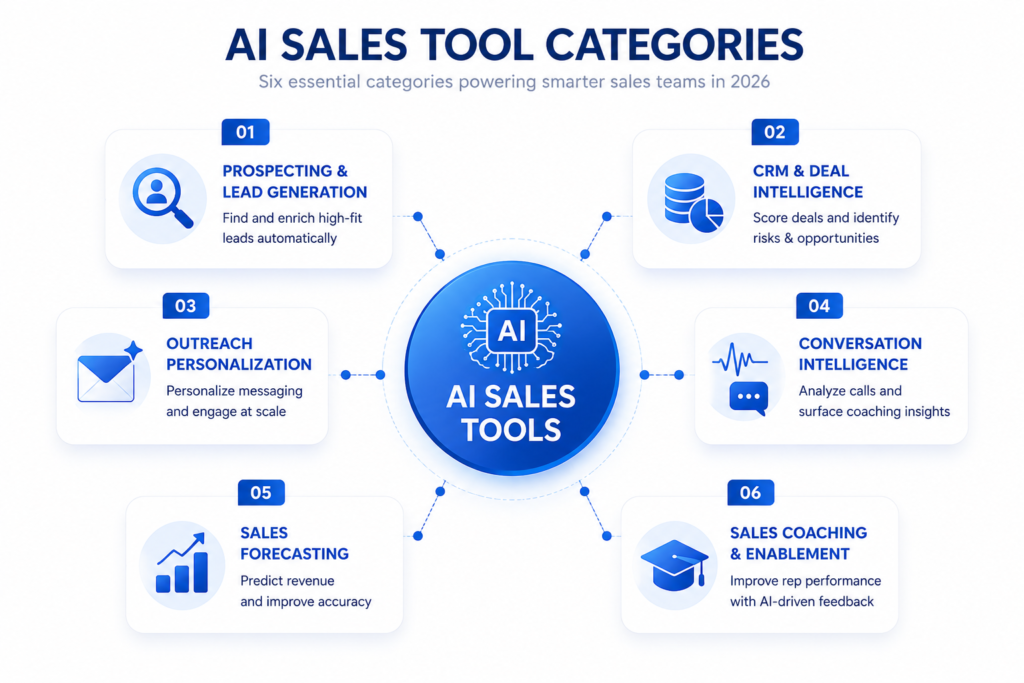
This guide breaks down the main categories of AI sales tools available today, highlights specific tools worth evaluating in each category, and gives you a practical framework for choosing the right ones for your team. At a glance, the main categories covered are:
- AI prospecting and lead generation tools: find and enrich high-fit leads automatically
- AI-powered CRM and deal intelligence: score deals and predict outcomes inside your existing CRM
- AI sales assistants and outreach personalization: draft and personalize outreach at scale
- Conversation intelligence and call coaching: analyze sales calls for coaching and deal risk
- AI sales forecasting: predict revenue outcomes from pipeline data
- Sales coaching and enablement: help reps improve performance with AI-driven feedback
Rather than ranking tools by popularity, this guide groups them by what they actually do so you can match a tool to a real gap in your sales process, not just a trending name.
What Are AI Sales Tools?
AI sales tools are applications that apply artificial intelligence to specific parts of the sales process, research, outreach, conversation analysis and forecasting instead of just storing and organizing data the way traditional sales software does.
The key difference is behavior: a traditional tool waits for a rep to enter information and act on it, while an AI sales assistant software actively analyzes data, generates recommendations, and in some cases takes action on its own. This distinction matters because “AI sales software” has become a loose label.
Some products bolt a chatbot or a “smart” filter onto an existing platform and call it AI. Others are built around AI from the ground up, where the model is doing real analytical or generative work drafting an email, scoring a lead, flagging a deal at risk rather than just decorating an old workflow.
Three capabilities define genuine AI sales assistant software today:
- Pattern recognition at scale: analyzing thousands of past deals, calls, or emails to surface patterns a human wouldn’t catch manually (e.g., which talk-track correlates with closed-won deals).
- Natural language generation: drafting outreach, summarizing calls, or writing follow-ups in a way that reads as if a rep wrote it, not a template.
- Predictive and prescriptive output: not just reporting what happened, but forecasting what’s likely to happen and recommending next steps.
A tool that does none of these even if it’s marketed as “AI-powered” is likely just automation with a new label. A genuine AI sales tool does at least one of the three consistently, and the strongest platforms combine all three.
This is also where AI sales tools start to overlap with the CRM itself. Many CRMs, including Microsoft Dynamics 365, now embed AI capabilities directly rather than requiring a separate bolt-on tool, a distinction worth understanding before evaluating standalone ai sales software, which we’ll return to later in this guide.
Categories of AI Sales Tools
AI sales tools fall into a handful of distinct categories, each solving a different part of the sales process. Understanding these categories first makes it much easier to evaluate specific products later, since most vendors fit clearly into one or two of them.
AI Prospecting and Lead Generation Tools
AI prospecting tools are platforms that use machine learning to find, enrich, and prioritize leads that match a defined ideal customer profile. Instead of a rep manually searching directories or LinkedIn, these tools scan large datasets and surface contacts most likely to convert, often enriching each lead with firmographic and intent data automatically.
In real life: instead of a rep spending their morning scrolling through LinkedIn profiles one by one, they open their tool and a list of good-fit leads is already sitting there, sorted by who’s most likely to actually reply.
AI-Powered CRM and Deal Intelligence
This category covers tools that layer predictive scoring and risk analysis on top of CRM data. They analyze deal activity, email response times, stakeholder engagement, deal velocity to flag which opportunities are likely to close and which are at risk of stalling, often before a rep notices the warning signs themselves.
In real life: a deal that’s gone quiet for two weeks gets flagged automatically, so the rep follows up before the prospect has fully checked out, instead of finding out too late.
AI Sales Assistant Software and Outreach Personalization
An AI sales assistant software platform drafts, personalizes, and sometimes sends outreach on a rep’s behalf, using AI to tailor messaging to each prospect rather than relying on static templates. These tools typically pull in signals like recent company news, job changes, or website activity to make outreach feel individually researched.
In real life: instead of typing out another “just checking in” email, a rep gets a draft that already mentions the prospect’s company launched a new product last week, so it actually feels personal.
Conversation Intelligence and Call Coaching
Conversation intelligence tools record, transcribe, and analyze sales calls to extract talk-time ratios, sentiment, competitor mentions, and objection patterns. The output is used both for coaching individual reps and for surfacing deal risk that wouldn’t show up in CRM notes alone.
In real life: a manager reviewing last month’s lost deals notices the same pricing objection came up on almost every call, something that’s nearly impossible to catch by listening to calls one at a time.
AI Sales Forecasting
Forecasting tools apply predictive models to historical and current pipeline data to project revenue outcomes with more accuracy than manual, rep-driven forecasts. Rather than relying on a rep’s subjective confidence level, these tools weigh deal signals statistically to produce a probability-based forecast.
In real life: instead of a manager asking “how confident are you this closes?” and getting a gut-feeling answer, the tool looks at the actual deal signals and gives a real percentage.
Sales Coaching and Enablement
This category focuses on ongoing skill development, using AI to analyze rep performance over time and recommend targeted coaching, training content, or messaging adjustments. It overlaps with conversation intelligence but is oriented toward long-term rep development rather than single-deal risk.
In real life: a rep who keeps struggling specifically on discovery calls gets pointed straight to training for that exact skill, instead of a generic “sales tips” course that doesn’t address the real gap.
Best AI Sales Tools in 2026
This section highlights specific AI sales tools worth evaluating in each category covered above. None of these are ranked against each other. The right tool depends on team size, budget, and which part of the sales process needs the most help.
AI Prospecting and Lead Generation
Apollo.io
- What it does: combines a large B2B contact database with email sequencing and AI-assisted outreach in a single platform
- Best for: small to mid-size teams that want an all-in-one, low-cost entry point
- Price indicator: $
Clay
- What it does: a data enrichment and workflow automation platform that pulls from dozens of third-party sources, letting teams build custom prospecting logic instead of relying on one predefined dataset
- Best for: revenue operations teams with the technical bandwidth to build and maintain custom workflows
- Price indicator: $$
ZoomInfo
- What it does: pairs one of the largest B2B contact databases available with AI-powered account scoring and intent data
- Best for: enterprise teams in regulated industries that need verified phone and contact accuracy
- Price indicator: $$$
AI-Powered CRM and Deal Intelligence
Microsoft 365 Copilot for Sales
- What it does: brings AI-generated deal summaries, email drafting, and CRM-aware insights directly into tools sellers already use, including Outlook, Teams, and Dynamics 365
- Best for: organizations already standardized on the Microsoft ecosystem
- Price indicator: $$
Salesforce Einstein
- What it does: applies predictive scoring and AI-generated insights natively inside Salesforce, surfacing which deals are likely to close based on historical pipeline patterns
- Best for: Salesforce-native teams that want deal intelligence without adding a separate tool
- Price indicator: $$$
AI Sales Assistants and Outreach Personalization
Outreach
- What it does: combines AI-assisted sequencing with deal insights and forecasting for structured, multi-touch outbound campaigns
- Best for: mid-to-large teams running high-volume, sequence-driven outbound
- Price indicator: $$$
Conversation Intelligence and Call Coaching
Gong
- What it does: records, transcribes, and analyzes sales calls to surface talk patterns, competitor mentions, and coaching opportunities tied to actual deal outcomes
- Best for: large sales organizations focused on coaching rigor and deal inspection at scale
- Price indicator: $$$
Fireflies.ai
- What it does: records, transcribes, and summarizes sales calls with searchable transcripts
- Best for: smaller teams that want clean call records without a full enterprise platform
- Price indicator: $
AI Sales Forecasting
Clari
- What it does: a revenue operations platform built around forecasting and pipeline governance, predicting whether a team will hit its number based on actual deal signals rather than rep confidence ratings
- Best for: organizations where forecast accuracy and pipeline visibility are a leadership-level priority
- Price indicator: $$$
Sales Coaching and Enablement
Mindtickle
- What it does: focuses on rep onboarding, skill development, and structured training content tied to real performance data
- Best for: sales organizations with a formal enablement function and structured ramp programs
- Price indicator: $$
Key Benefits of AI Sales Tools
AI sales tools deliver measurable benefits across the sales process, from time saved on manual work to more reliable revenue predictions. These benefits compound: time saved on admin work translates directly into more time for selling, which is where the productivity gains below actually show up.
Productivity and Time Savings
AI sales tools remove much of the manual research, data entry, and admin work that eats into a rep’s day. High-performing teams that successfully automate routine tasks free up roughly 20% of seller capacity, which translates into a 30% improvement in overall team productivity, according to McKinsey & Company research cited in a 2026 sales performance benchmarking report.
Sales professionals who actively use AI sales assistant software are also significantly more likely to hit quota than those who don’t, based on the same 2026 benchmarking data.
Faster, More Accurate Lead Qualification
Rather than manually researching and qualifying every inbound or prospected lead, AI-based lead prioritization helps reps focus on the contacts most likely to convert. AI’s impact on lead generation includes improving forecast accuracy by 25% and boosting lead-to-opportunity conversion by 28%, according to a 2026 industry statistics report.
Improved Forecasting Accuracy
Forecasting is one of the clearest places where AI sales assistant software and deal-intelligence platforms outperform manual methods. Median B2B forecast accuracy sits at 70-79%, while AI and machine learning methods reduce forecast variance to roughly ±8-15%, a meaningful, though not dramatic, improvement over manual roll-ups.
It’s worth noting that AI forecasting tools are only as reliable as the CRM data feeding them; inconsistent data entry is cited by 56% of organizations as a major obstacle to AI adoption, which is a useful caveat before assuming any forecasting tool will fix a messy pipeline on its own.
Personalization at Scale
AI sales software makes it possible to personalize outreach for hundreds of prospects without writing each message from scratch. Across industries, 63% of organizations now use generative AI and report clear productivity gains as a direct result, a trend that extends directly to AI-generated sales outreach.
Stronger Adoption-Driven ROI
The financial case for adopting AI sales tools is increasingly well-documented. 86% of sales teams using AI report positive ROI within their first year, including cost savings, increased pipeline, reduced admin time, and improved win rates.
Not sure which AI sales tools are right for your team?
Choosing between dozens of overlapping platforms is harder than it should be and the wrong choice can cost months of adoption time. Book a free consultation with MP-365 and we’ll help you map the right AI sales tools to your actual sales process, your CRM, and your team’s workflow. Book Your Free Consultation: Contact Modern Partners 365.
How to Evaluate and Choose AI Sales Tools
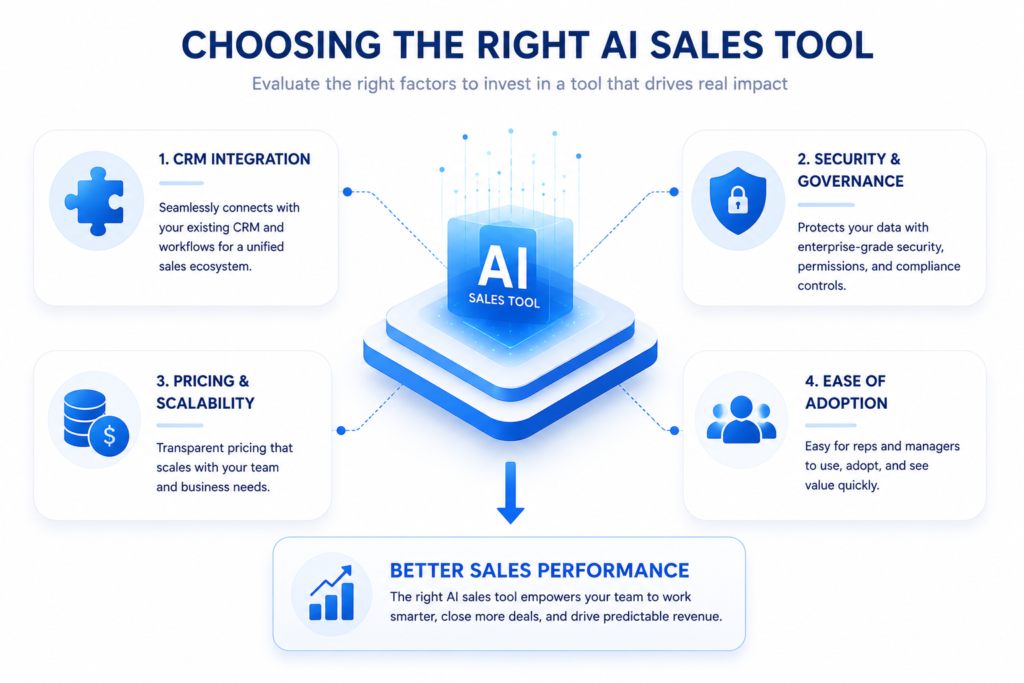
Choosing the right AI sales software isn’t about finding the tool with the most features, it’s about matching a tool to a specific, real gap in the sales process. The following framework covers the four factors that matter most when evaluating any AI sales assistant software or platform.
CRM Integration Depth
- Check how deeply a tool integrates with the CRM the team already uses native, bi-directional sync vs. manual export/import
- A tool that doesn’t sync automatically in both directions creates more work than it saves
- Most AI sales tools are meant to sit alongside a CRM, not replace it, so a tool that fights the existing system tends to get abandoned regardless of how capable it looks in a demo
Data Security and Governance
- Confirm the tool meets baseline enterprise security standards: data encryption, role-based permissions, recognized compliance certifications relevant to the industry
- Pay close attention to tools that process call recordings, emails, or CRM records, since that data often falls under regulatory requirements like GDPR
- Ask specifically how the vendor handles data retention and whether customer data is used to train models across other customers
Pricing Model and Scalability
- Most AI sales tools use one of two pricing structures: per-seat licensing or usage/credit-based pricing
- Per-seat pricing is more predictable for budgeting; usage-based pricing can scale unpredictably for high-volume prospecting or enrichment needs
- Model what the tool would cost at double the current team size before committing usage-based tools in particular can get expensive fast as adoption grows
Ease of Adoption
- A tool only delivers value if reps actually use it day to day
- Sellers managing a tech stack of 10 or more tools are notably less likely to hit quota, so adding another tool without retiring or consolidating an existing one can do more harm than good
- The smoothest adoption curves tend to come from AI sales software that fit into a rep’s existing workflow inside the CRM, inside the inbox, inside the call window rather than requiring a separate tab or login
Common Pitfalls When Adopting AI Sales Tools
Even well-chosen AI sales tools can fail to deliver value if a team falls into one of a few common traps during rollout.
Tool Sprawl
- The average sales tech stack now includes 10 or more tools
- Sellers overwhelmed by that sprawl are meaningfully less likely to hit quota
- Adding another AI tool on top of an already bloated stack usually creates more friction than it removes, consolidation is often more valuable than addition
Choosing Features Over Outcomes
- It’s easy to be impressed by a long feature list in a demo and lose sight of the specific problem the tool was meant to solve
- The better approach: identify the single biggest bottleneck in the sales process first, then evaluate tools strictly against whether they fix that bottleneck
- A tool that does ten things adequately is often less useful than one that does the actual bottleneck task very well
Skipping Pilot Programs and Stakeholder Buy-In
- Rolling a new AI sales tool out to an entire team at once, without a pilot group or manager buy-in, is one of the most common reasons adoption stalls
- Reps who weren’t consulted, or don’t trust the tool, tend to quietly ignore its recommendations rather than actively rejecting it
- That quiet disengagement makes the failure harder to spot early, since usage metrics can look fine while actual reliance on the tool’s output stays low
Underestimating Data Quality Requirements
- AI sales tools, especially forecasting and deal-intelligence platforms, are only as good as the CRM data they’re built on
- Inconsistent stage definitions, stale close dates, or missing fields lead to unreliable output regardless of how sophisticated the underlying model is
- Worth auditing CRM data hygiene before expecting a forecasting tool to fix accuracy on its own
AI Sales Softwares and Modern CRM Ecosystems
Most of the categories covered in this guide work alongside a CRM rather than replacing it, which means the value a team gets from any AI sales tool depends heavily on how well it fits into the CRM ecosystem already in place.
For teams on Salesforce, that often means evaluating Salesforce-native AI like Einstein before adding a separate platform. For teams on the Microsoft stack, the calculation is different: Microsoft 365 Copilot and its sales-specific capabilities are built to work directly inside Outlook, Teams, and Dynamics 365, which changes which standalone AI sales tools are actually worth adding versus which capabilities are already covered natively.
This is where the right starting question shifts from “which AI sales tool is best?” to “which AI sales tools actually add something my CRM doesn’t already do well?” and for organizations running Microsoft Dynamics 365 specifically, that question has enough nuance to deserve its own breakdown.
Conclusion
AI sales tools have moved from a competitive edge to a baseline expectation for B2B sales teams. The teams getting real value from them aren’t the ones chasing every new product launch, they’re the ones who started with a clear bottleneck, picked a tool that solves that specific problem, and made sure it fit cleanly into the CRM and workflow already in place.
The framework in this guide is meant to make that process simpler:
- Understand the categories of AI sales tools before evaluating individual products
- Match a tool to a real gap, not a feature list
- Evaluate AI sales software on CRM integration, security, pricing model, and ease of adoption not just capability
- Watch for tool sprawl and skipped pilots, since both quietly undermine adoption even when the tool itself is a good fit
Whether the goal is faster prospecting, better forecasting, or more consistent coaching, the right AI sales assistant software is the one that removes a real bottleneck without adding a new one in its place.
If your team is evaluating AI sales tools and wants help mapping the right ones to your existing CRM and sales process, MP-365 offers a free consultation to walk through your specific setup and recommend a path forward.